THE BIRTH
AND BOOM
OF SHOOTER GAMES
When we really think about shooter games,
our mind already falls into massive stages
and cinematic scenes from modern-era FPS games.
This is simply what we are used to seeing nowadays. However, one, if not the most popular gaming genre, started way before
we could even seize the concept of an FPS.
For anyone who grew up with video games,
the feeling of aiming and firing a pixelated weapon was something unique.
This genre changed as technology evolved.
We went from clunky moves with basic
targets to fast, tactical, and online arenas.
No matter which era of shooters you lived in, they all left a mark that defined whole generations of gamers. Whether you are
a fan or not, you may agree with this.
I doubt you have never felt curious about aiming a cool pixel gun. Join us in tracing the journey of this genre, shot by shot!
Writer: Bambie
Designer: Myra
Date: 01/12/2025
Time to read: 15 mins
The first shot was heard in space!
Before shooter games conquered gamers’ hearts and esports stages, the genre had quite a humble start.
Imagine a handful of developers thinking about how a PC can make them feel like
a weapon is being fired. One of the early attempts to answer that question was
a game called Spacewar!
Seeing the light in 1962 and on a machine that was most likely the size of a fridge, this game was made by MIT students.
They basically treated a giant university computer as their personal playground
and did not really use it for its intended purpose, as computers back then were exclusive to research only.
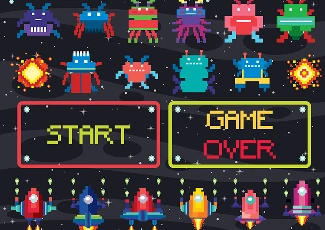
The idea was simple: two ships drifting in space, firing at each other while trying not to get sucked by a star’s gravity.
The game was not precisely a shooter in the modern sense. It instead introduced the idea of aiming and shooting enemies
in real time. Reflecting on the era it was made in, people perceived it as some
sort of black magic gameplay.
Despite not being officially published or sold, in a peculiar way, it became one
of the first “viral” games to ever exist.
Aiming for something big!
Arcades pulled the trigger!
These games were more than just two little ships drifting in a lab room. We had hordes of aliens being shoved in the middle of our screen, there were patterns to memorize, bullets to dodge, and all of it while trying
to get a high score.

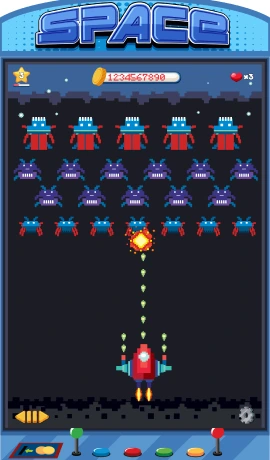
After Spacewar! showed what it feels like to shoot head-to-head; it was a matter of time for the idea of fast shooting to kick off and ignite the next mainstream thing. Arcades became the place where this energy exploded, and in the late 70s
and the early 80s, video games like Space Invaders and Galaxian did something that stuck with kids of the era. They gave this rush feeling and excitement we get when reacting, aiming, and surviving under very high pressure.
For the first time, shooting wasn’t the main mechanic. It was the identity of the game. Kids got in crowded queues waiting for their turn to play, while we heard the coins clinking in their pockets.
Arcade shooters sort of created a mindset that would shape the future of FPS games. Think about fast reactions, arenas full of enemies, and the continuous self-push to improve your score. They turned around
the shooting aspect of it into an experience that players did not know they craved for.
Chaos, adrenaline, and the excitement of beating a chaotic scene. All of this set
the ground for first-person gun combat.
The first glimpse of 3D shooters
The next big step taken after arcades was when the concept of 3D started creeping in. Players had already fallen in love with the idea of fast reactions and shooting under high pressure.
What if we intensified this feeling a little
bit more? How could we get players even more immersed?
Enters Battlezone, a game put out in 1980, also for arcades. Though the game looked nothing like Space Invaders. It wasn’t a flat screen with lots of targets, but rather some tank looking out at a wireframe battlefield.
One must admit, it was something quite primitive, but it was not the type of thing you see every day.
In Battlezone, you could move the joystick, and the whole panorama shifted in front
of you. This era experienced a few other experiments that would ultimately lead
to modern FPS games. It was the future
of fast-paced gaming. We had a couple of dungeon crawlers on PC that were using
first-person views, allowing players to run through corridors. During the late 1980s,
as technology evolved, PCs started to be more accessible. Graphics were slightly less blocky, and developers got hungrier. Shooter games became more popular,
and we were craving for something big.
Shifting your perspective!
Locked and Loaded for success!
Instead, you were now someone holding
a gun, sprinting down creepy corridors, blasting random guards, and hunting for secrets. This was the first real feeling of immersive shooting. The gamers were embracing it with all their might.
By the early 90s, the few experiments done so far had fulfilled their intended purpose. Giving developers enough time to poke around the 3D. As hardware got stronger,
a small company called id Software said,
“Alright, watch this.”
In 1992, a game called Wolfenstein 3D was released. It felt quite like a slap in the face to everything seen so far. You were not in
a tank moving randomly, and certainly did not see green lines pretending to be some pixelated mountains.

Wolfenstein may not have been a 3D game by today’s standards, but that was no issue to players back then. For them, it was raw energy invading their body.
The genre had discovered its true identity, and id Software was not even close to being remotely done.

Multiplayer joins the battle!
Players would gather to form LAN parties, creating a cultural moment for an entire generation. Doom was the shooter.
Doom is to this very day one of the biggest,
if not the most important contribution to
the shooter genre, and we dare to say for gaming in general.
Only a year later, we saw the birth of Doom. And here is when things get a bit explosive. Everything people liked about Wolfenstein, Doom made it bigger, faster, and let’s just say simply cooler.
Enemies felt intimidating, guns had punch, and the levels kept you alert at all times. The cherry on top: the multiplayer feature!
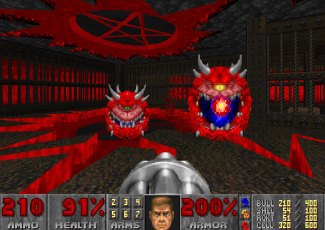
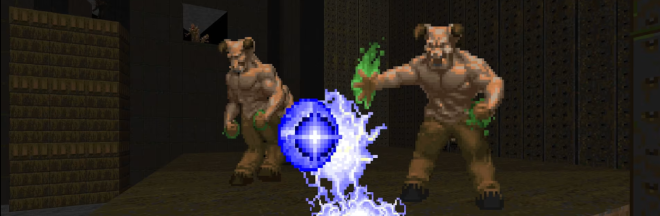
Anything that came after it has attempted to replicate the same feeling, and that still happens to this day.
That was the moment the FPS genre had officially taken over the gaming industry. The shooter games became a force to
be reckoned with.
Quaking the industry!
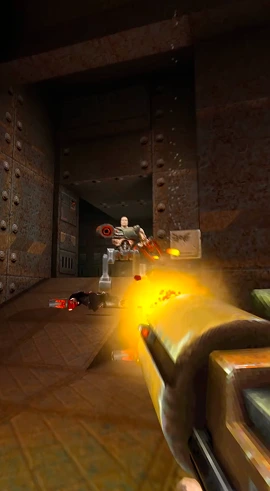
At this point, kids were expecting a meteor in the industry, and that was exactly what Quake was. Doom had already written all the rules, but Quake obliterated them.
This was full 3D. Polygons with real depth and verticality. It was a world that felt like
it was swallowing you whole.
Quake had such a memorable soundtrack. One that set the atmosphere to the feeling of descending into a forgotten nightmare dimension that did not want you there.
The game ignited the first spark that may have led to esports. This was the birth of arena shooter culture.
From here on, the genre paved for success. Something people did not expect was for shooters to be playable on a controller.
This is when GoldenEye 007 shut everyone up. The title introduced smart level design, AI that reacted to you, stealth mechanics, and a split-screen feature that left players
jaw-dropped. The next success was Valve’s Half-Life, and some people say this is when games truly learned to speak.
Half-Life’s world was telling you its story. Players were not just shooting their way through levels, but they were surviving them. This was an industry rewiring.
The 2 biggest steps!
Carrying the legacy!
And why, you ask? They were such a huge influence on technological advancements. Without these experiments, we would not
be where we are today. They shaped entire communities and long-lasting friendships.
This is evidence that progress never stops. Not only for shooters, but for any kind of vision that creative minds will have.
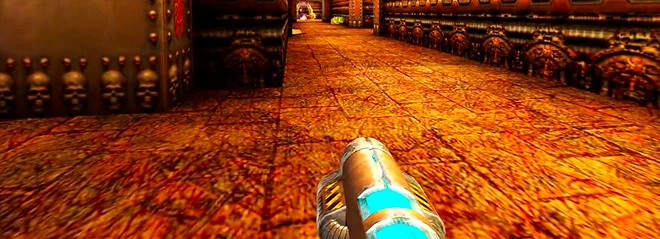
Everything shared so far is the foundation of shooters. We have much more ground to cover regarding the genre’s milestones,
and for that, we will have a second part to discuss the modern era FPS titles.
Obviously, we are not forgetting the heavy influence on esports, and looking back at everything, it is wild to realize how fast
the genre evolved. Going from simple halls and pixelated enemies to entire universes that feel alive. Every jump the genre made did not just improve the previous games.
It redefined players’ experience and feel.
Games like Doom and Quake showcased
a real and raw attitude. They were cultural pivots for those generations.
If you stop to think about it, every new FPS that drops is echoing the code of those classic shooters in some way or another. And that, my friend. is the legacy these industry titans left behind.